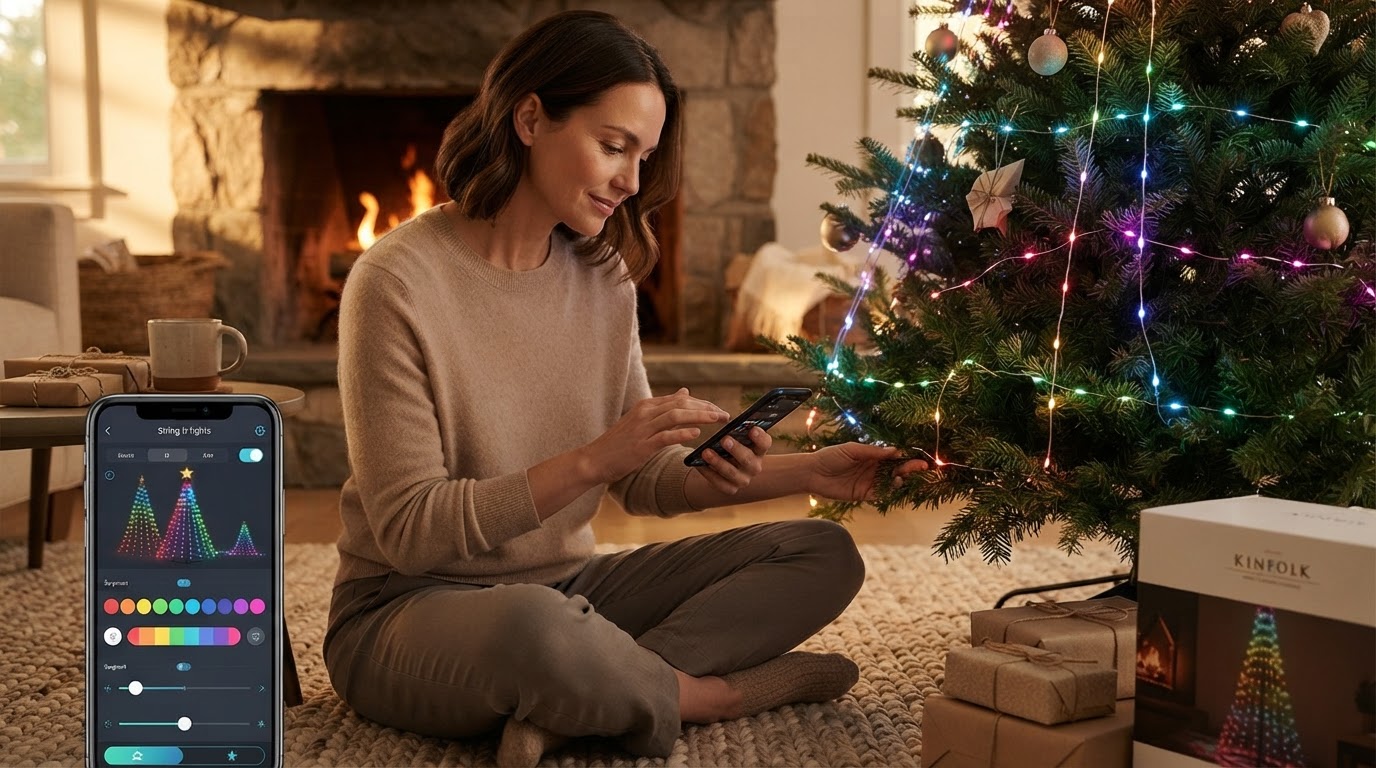
Mastering RGBIC Smart Christmas Tree Lights Displays
 Priya RamanSenior Analyst
September 18, 2026. This review examines the technical evolution of RGBIC lighting within the holiday sector, specifically focusing on how multi-zone control transforms standard decor. It is intended for homeowners seeking to move beyond basic presets toward granular, app-driven customization.
To evaluate these systems, think of it as a matrix of three distinct dimensions: addressability, connectivity, and algorithmic intelligence. When these three axes align, the lighting system transitions from a simple static display to a dynamic environmental asset. Understanding the shift from standard RGB to RGBIC (Independent Control) is the first step in applying the Smart Christmas Tree Lights Selection Framework to your seasonal setup.
The Technical Limitations of Traditional String Lighting
Standard LED strings operate on a global circuit where every bulb receives the same voltage and color command simultaneously. While this allows for basic flashing or color-shifting, it lacks the spatial awareness required for modern digital art. The emergence of RGBIC technology addresses this by embedding a dedicated Integrated Circuit (IC) into the string, allowing for individual segment control. According to Govee Christmas String Lights 2 documentation, their Uni-IC Control technology enables 16 million colors to be displayed across a single strand, creating mesmerizing effects that were previously impossible with serial-wired bulbs.
Without this independent control, users are limited to "chase" patterns that feel mechanical and repetitive. The market demand for Smart Christmas Tree Lights for App-Controlled Decor has surged because consumers are no longer satisfied with the binary choice of warm white or multi-color. The problem is one of resolution; traditional lights are low-resolution, while RGBIC lights function more like a distributed screen wrapped around a tree. This high-density control is particularly evident in hardware like the Smart RGBIC Christmas Tree Lights with 480 LEDs, which utilizes 24 individual strings of 6.6 feet to ensure complete coverage and complex pattern mapping. When users search for what are the best Smart Christmas Tree Lights alternatives?, they are often looking for this specific level of granular brightness and color fidelity that cheaper, non-IC strings cannot replicate.
Advancing Beyond Presets with AIGC and Voice Control
Smart Christmas Tree Lights bridge the gap between hardware and software through sophisticated application layers. As noted in the Govee Christmas Sparkle String Lights Review on YouTube, these systems now incorporate AI-generated content (AIGC) features that allow the lights to respond to prompts or environmental cues. This moves the user experience away from manual color picking toward a generative model where the lights adapt to the room's mood. The integration of WiFi and Bluetooth ensures that these commands are executed with minimal latency, a critical factor when synchronizing lights to music or using voice commands via Alexa or Google Assistant.
Two axes matter here: the depth of the software ecosystem and the physical durability of the LEDs. While many generic options exist, the reliability of the connection determines whether the "smart" aspect is a convenience or a frustration. Systems that utilize Matter or robust proprietary apps allow for easier integration into wider home automation routines. When considering Smart Christmas Tree Lights for App-Controlled Decor, the ability to group multiple strands and treat them as a single canvas is a primary differentiator. The AIGC features mentioned in the Govee Christmas Sparkle String Lights! With AIGC and Smart Control! video highlight how 16+ million color options can be harnessed through smart algorithms to create professional-grade light shows without requiring a background in DMX programming. This democratization of high-end lighting tech is what defines the current generation of best smart tree lights 2024 trends.
The RGBIC Implementation Decision Matrix
Once you see it this way, the selection process becomes a matter of matching hardware density to your specific aesthetic goals. The decision rule: prioritize LED density and IC frequency if you intend to run complex animations, but focus on waterproof ratings and lumen output if the installation is primarily for outdoor visibility. A dense 480-LED setup is ideal for a 7-foot indoor tree, whereas a lighter, more durable strand might be better for porch railings or exterior foliage. Before finalizing a purchase, consult the best Smart Christmas Tree Lights alternatives to ensure the software matches your mobile device’s operating system and your home's network bandwidth.
Use this checklist to verify your requirements:
- Confirm the presence of "IC" in the specs to ensure individual segment control rather than whole-string color changes.
- Verify the LED count per foot; higher density (such as 20 LEDs per 6.6ft string) results in smoother gradients.
- Check for AIGC or music-sync capabilities if you intend to use the lights as a centerpiece for entertainment.
- Ensure the power supply and controller match the environment (IP65 or higher for outdoor use).
- Validate compatibility with existing smart home hubs to avoid fragmented control apps.
Shop Smart Christmas Tree Lights here.
Sources
- Govee Christmas String Lights 2
- Govee Christmas Sparkle String Lights Review - YouTube
- Smart RGBIC Christmas Tree Lights 480 LEDs Waterproof Voice Control ...